Showing posts with label Four legs good. Show all posts

Wednesday, October 23, 2024

The dogless days of summer


Bookends; Ravi at the river at about T minus five weeks

Each Labor Day weekend for twenty years past we and our dog or dogs have accompanied chum G to her dacha, a rustic “vacation cabin” on Forest Service land in the Sierra foothills. There on Redacted Creek and, currents permitting, the nearby American River, we sun ourselves and splash about. Afternoons and evenings we chat, visit other lucky leaseholders, grill flesh, fish, fowl, catch up on back issues of the NYRB, with which the cabin is stocked in abundance. And the dogs, hers and ours, go traipsing through the forest, snuffling the expanded spectrum of smells (“Jeepers! Is that really bear scat?”) laid out for their delectation, to all appearances a welcome and exotic change from the urban message boards (“Reply all”) of their Oakland strolls.

This year, to our regret, considerations of health obliged us to break the cycle: it would not be feasible at this stage of her affliction for Lina to be a two-hour drive from her medical team, and they tell me that the cost of a ride in a medevac helicopter has gone through the roof. Accordingly we were not on hand to help G “close up the cabin” (as we “opened” it last Memorial Day) this time out.

In 2023 we managed September the trip, and so did poor Ravi, by then increasingly frail and incontinent (two words: “whelping pads”), who slept much of the day but who would eagerly bestir his sixteen year-old bones and totter outdoors whenever a turn along the trails was on offer. It proved his last hurrah. By October, as the slope of his decline steepened, we had begun having “the conversation”: we’d long felt that, however onerous his care might become, we would preserve the creature for as long as he appeared to enjoy his life as a dog more than not, and it was beginning to feel as though his morale was faltering. By the first weekend in the month we were thinking “This will probably be the week,” and Sunday afternoon his condition went gruesomely off the cliff. On Monday (“Indignant People’s Day” as we call it around here) we carried him to the car and drove down the freeway to “Creature Comforts,” whose head vet Ravi always liked and trusted—for example, he never flinched as we drove into their parking lot.

For the last quarter hour of his life, he tottered and sniffed around CC’s enclosed yard. A blanket was laid out for him; invited to lie down upon it, he did. Lina stroked his ears and Dr. W administered a sedative that induced slumber and then a compound that slowed and then stopped that noble heart. Lina held it together better than I did: I wept—I will not say unashamedly, because that’s not how men of my cohort and background roll, but as discreetly as I could, blotting up several sheets of tissue.

And so we have been a year and change now without the companionship of our dog, who brought such delight to our lives for almost fifteen years. He was released from the burden of his old age; we from his maintenance. It would not have been otherwise possible for us to leave home for ten days last spring chasing the total eclipse out at sea. And although we have both felt keenly impoverished for want of a canine presence in our lives since then, I would have been hard pressed to give even a healthy dog the time, energy and attention it would be entitled to, as Lina’s care has become increasingly a full-time undertaking. And when Lina is gone, which seems as though it must inevitably occur in the coming weeks, I don’t know that I could in conscience take on a pet whom I might leave bereft. But if this household is never to include a dog again, I take some comfort in reflecting that with Ravi we saved the best for last.

Friday, July 3, 2020

Just because


A dog and his squeaky toy, repurposed as a pillow. Sound asleep. Is he cute, or what?

Saturday, September 21, 2013

Further to dog cognition

Comment would seem superfluous.

Wednesday, February 13, 2013

Dognition


“Outside of a dog, a book is man’s best friend. Inside of a dog…” well, you know.

A great deal of highly entertaining, vastly ill-informed, largely anthropomorphic material has been written over the centuries on canine intelligence. The following entry is my modest contribution to this venerable undertaking.

Daniel Dennett, a philosopher whose work I’ve followed and admired for many years, has written extensively on the phenomenon of consciousness, and on evolution by natural selection (Darwin’s Dangerous Idea, largely devoted to the latter, includes an excellent chapter on the former, enlarging on ideas earlier set forth in the audaciously-titled Consciousness Explained). He once observed (or so I would have said until a few months ago when I attempted to locate the vaguely-remembered citation) something to the effect that notwithstanding our close genetic kinship with the higher primates, it has been Canis lupus familiaris, the common dog, and not the chimp, bonobo or gorilla, that has been under intense selective pressure for the species’ last four thousand generations or so to understand human language. For at least 15,000 years, humanity has been the livelihood of the dog. Upon our toleration and goodwill the dog has relied, and these elements it has attempted to conduce after hard study. Market demographers may bring to bear more sophisticated tools to their assignments, but Rover has a good deal more fur in the game. The stakes (and the steaks, adds my own pet, anticipating this evening's table scraps) are very high.

I could be mistaken about Dennett, incidentally. Much of what I've googled as I've prepared for this essay suggests that he’s not inclined to credit Man’s Best Friend with the “intentional stance,” a term he devised to describe a form of sentience that possesses both an interior mental state and an awareness that other beings are possessed of interior mental states. Now as it happens, researchers (no doubt funded by your taxes, by the sweat of your brow, droplets of dollars that might be better funneled into the development of more lethal unmanned aircraft) have lately caught out squirrels in two different patterns of behavior as they secrete nuts against future need: if the squirrel is confident that it is unobserved by one of its fellows, it will go ahead and bury the savory treat. If it believes itself watched, however, it will go through the motions of hiding its treasure underground, but will actually leave the scene with the nut stuffed in its cheek, subsequently burying it in a location deemed more secure. This certainly looks to me like the intentional stance manifested in a brain not much larger than, well, an acorn. I’m going to guess that even a relatively stupid dog can rise to this level of abstraction.

Placed in the south forty (square yards) for the purposes of voiding his bladder or bowels, or merely patrolling the perimeter to make it inhospitable to the raccoons or possums or (shudder) families of skunks that occasionally send scouts behind the house, Ravi the family dog will signal his readiness to return to the interior by scratching politely, and lightly, on the kitchen door. If after a couple of repetitions he receives no response, he will ramp up the gesture with considerably more energy. On one occasion, when the spousette and I had retired with each of us supposing that the other had readmitted the pet, I was awakened an hour later by the violent and unprecedented clatter of dog claws on a bedroom window, suggesting to me that the creature (a) knew where we were and (b) brought to bear the intentional stance in his apparent belief that we possessed attention to be roused and that proximity was likely to be efficacious in securing that attention.

When I was a child, the prevailing notion of animals in the culture was something along the lines of Cartesian automata. They were governed by “instinct,” which alone produced flinches or howls if the creature was struck: no actual pain was experienced. Alongside this received wisdom, of course, people still spoke to their pets and lavished affection on them, but many did so while simultaneously believing that there was no one home, that they were sharing their lives with what amounted to furry appliances bereft of emotions, much less of any higher cognition. Much more recently (well, 1999) there was an article in The Atlantic (featured on the cover as “Why Does Your Dog Pretend to Like You?”) that painted the pooches as evolutionary opportunists:


If some advertiser or political consultant could figure out just what it is in human psychology that makes us willing to believe that dogs are loyal, trustworthy, selfless, loving, courageous, noble, and obedient, he could retire to his own island in the Caribbean in about a week with what he would make peddling that secret. Dogs belong to that select group of con artists at the very top of the profession, the ones who pick our pockets clean and leave us smiling about it. Dogs take from the rich, they take from the poor, and they keep it all. They lie on top of the air-conditioning vent in the summer; they curl up by the fireplace in the winter; they commit outrages against our property too varied and unspeakable to name. They decide when we may go to bed at night and when we must rise in the morning, where we may go on vacation and for how long, whom we may invite over to dinner, and how we should decorate our living rooms. They steal the very bread from our plates (I'm thinking here of a collie I used to have whose specialty actually was toast). If we had roommates who behaved like this, we'd be calling a lawyer, or the police.

I approach the subject of dog sensibilities without professional credential. I’ve shared quarters with canines for about twenty-five years out of the four-plus decades since I left the parental premises to seek my fortune—an elusive target, to be sure—and have derived considerable moral improvement from the experience. I could wish, looking back, that as a young man I’d been more attentive to the needs of Takoma (1971-1985; a series of common roofs during the latter nine years of his span), a preternaturally intelligent husky/border collie/Australian shepherd mix, and if I peer into the remote reaches of mid-adolescence there was Sam, an amiable mongrel of scrambled pedigree, who was devoted to me during our twenty months’ association. My post-nuclear family was a very unstable isotope in the mid-sixties, and another in a series of covalent cataclysms separated Sam and me forever in 1968.

I acquired Takoma, AKA “Tako,” by marriage in 1976. The poor dog expired early in 1985 after an abbreviated but harrowing decline, and the marriage followed suit the following year in a somewhat more prolonged but comparably grim endgame. I still tell the story of how one afternoon about a third of a century ago Tako approached me in my study—I was at work in those days on a novel for which I then still held high hopes—and repeatedly nudged my elbow. Well, that was properly the muse's place, and I brusquely ignored the dog with mounting irritation until he went to the kitchen, retrieved a spent tin of catfood from the trash, returned to the study and dropped the can with a clatter at my feet: looked at me, looked pointedly down, looked at me again. It occurred to me at that point that the creature had not eaten all day owing to my neglect, the spousette being out of town for the weekend, of the standard feeding drill. This is of course anecdotal evidence only, but it seems to me at least to imply an intentional stance, and then some.

Much more consistent attention was paid to Napalm (1993-2011; described elsewhere in this blog), whose behavior first led me to posit the (metaphorical) existence of a canine “language module,” an abstraction level spun up upon receipt of a human signal that verbal interaction impends. We used to joke that Napalm could parse moderately complex English sentences once he was convinced that table scraps were in play. I do believe that my hypothetical language module, requiring as it does in my model a certain expenditure of energy on the part of the dog, might explain in part the episodes of canine deafness with which we’re all familiar. Dogs are method actors: “what’s my motivation?” indeed. Ravi, then about a year old, joined the household at the end of 2008, and I have observed him perhaps too closely for any pretense of objectivity. It’s impossible for me not to be sentimental about him, but I don’t believe that familiarity has utterly debauched my critical faculties. I’ll report, you deride.

Tone of voice, physical presence, eye contact and body language probably precede phonemes. Ravi will lie at one end of the dining room during a dinner party, and the conversation will be background noise merely to him. No words will register. We adopt a special tone (at least half an octave higher than the normal conversational timbre in my case) in addressing him, and this appears to be processed as a signal for attention: the language module spins up. Usually an early phrase directed at the dog is either “Ravi?” (put language module in fifth gear!) and/or “Do you want…?”

Do you want is taken, I suspect, as a single unit of meaning, signifying to the dog that what follows the magic syllables is a proposition. Poor old Takoma well understood the difference between the subsequent “…go outside” (the back yard) and “go for a walk” (out to crap in Safeway’s ivy on Claremont Avenue) and would cower in the former instance or head enthusiastically for the vestibule in the latter. The late Napalm processed the phrase in like fashion, as does Ravi.

Ravi has only to hear the word “walk” pronounced with the appropriate inflection, or to see one of his leashes held up for his inspection in order to know that an excursion impends. He understands “treat” and “Happy Hips” (the brand name of a particularly coveted doggie delight—I speak it aloud when he dawdles returning from an excursion, and he tends to pick up the pace unless there’s a particularly provocative piece of pee-mail still being processed). On walks, which we undertake leashless wherever this is practical, he responds appropriately to “heel,” “hold it” and “wait for me” (urgency of tone is a factor in each case). Lina has been working to get him to process “go left” and “go right”; I remain as yet unconvinced that she’s made much progress toward that end (I think he’s responding much more to nonverbal cues here).

Let’s return for a moment to the Cartesian automata model to which I alluded above. Those who hold that dogs do not or cannot rise to the level of the intentional stance at least have the significant differences between primate and canine brains to back them up. But primal feelings? Rage, fear, anticipation, excitement, lust, pain—yes, and sorrow, and love—don’t these reach us from deeper substrates of our layered grey matter? The appreciation of a sonata (I do not, incidentally, believe that dogs process music, for reasons I may enlarge upon anon) engages our high-level processing, but grief? Loneliness? Shame? These may be mediated and experienced through higher levels of human consciousness, but they emanate from buried structures we share with our pets and, for that matter, with the beasts we carnivorous hominids routinely consume (another topic for a future blog entry).

Ultimately I think it matters less whether dogs actually understand our words—I believe that Ravi does, and there is experimental evidence to suggest that one particularly brilliant border collie (a breed universally acknowledged to occupy the upper reaches of canine cognition) has not merely mastered a vocabulary of over a thousand words, but can also process the rudiments (verb-subject) of grammar—than whether a spectrum interspecies communication that extends to a level of abstraction, language forming one band of this spectrum, is taking place. If it is, then something remarkable has occurred over the millennia, a development that eluded the grasp of the author of “Why Does Your Dog Pretend to Like You?” fourteen years ago. We have established a kind of communion, on a fairly sophisticated level, with an intelligent representative of the animals (there are others, of course. I believe that the connection with domestic cats is conducted at a significantly lower level of abstraction. I can’t speak from experience of horses or livestock), and at least among societies that can afford a class prosperous and indulgent enough to support household pets we have a population of, well, quislings. We humans are so routinely callous in our depredations upon the other animal species of this planet that if they were magically raised to sentience, their vision of the demonic would certainly take two-legged form. We have invaded and now occupy the planet as harshly and proudly as ever Nazis lorded over France, and yet…here there trot at our heels our very own collaborators, who may not have welcomed the human hegemony at the outset, but who have bound their fates with us and even (heaven help!) love us. We have an obligation to be kind to them, don’t you think?

Sunday, August 26, 2012

Another one over the side, alas


Connie, Gail Coney's cherished pooch, died early in August after a brief bout with a wasting disease (she is pictured here in July, shortly after its onset was first observed). Connie was a loyal dog, adored by all who knew her and particularly by our own Ravi, who will not again get to lick her ears.

A Dog Has Died

My dog has died.
I buried him in the garden
next to a rusted old machine.

Some day I'll join him right there,
but now he's gone with his shaggy coat,
his bad manners and his cold nose,
and I, the materialist, who never believed
in any promised heaven in the sky
for any human being,
I believe in a heaven I'll never enter.
Yes, I believe in a heaven for all dogdom
where my dog waits for my arrival
waving his fan-like tail in friendship.

Ai, I'll not speak of sadness here on earth,
of having lost a companion
who was never servile.
His friendship for me, like that of a porcupine
withholding its authority,
was the friendship of a star, aloof,
with no more intimacy than was called for,
with no exaggerations:
he never climbed all over my clothes
filling me full of his hair or his mange,
he never rubbed up against my knee
like other dogs obsessed with sex.

No, my dog used to gaze at me,
paying me the attention I need,
the attention required
to make a vain person like me understand
that, being a dog, he was wasting time,
but, with those eyes so much purer than mine,
he'd keep on gazing at me
with a look that reserved for me alone
all his sweet and shaggy life,
always near me, never troubling me,
and asking nothing.

Ai, how many times have I envied his tail
as we walked together on the shores of the sea
in the lonely winter of Isla Negra
where the wintering birds filled the sky
and my hairy dog was jumping about
full of the voltage of the sea's movement:
my wandering dog, sniffing away
with his golden tail held high,
face to face with the ocean's spray.

Joyful, joyful, joyful,
as only dogs know how to be happy
with only the autonomy
of their shameless spirit.

There are no good-byes for my dog who has died,
and we don't now and never did lie to each other.

So now he's gone and I buried him,
and that's all there is to it.

—Pablo Neruda

Friday, August 26, 2011

Rocky the Dying Squirrel

He has known sin at last, my gentle dog. Ravi has slain his first squirrel.

I had him at the corner park on Wednesday, and a squirrel that had been taunting him from relatively safe perches went scampering now and again dangerously close to the jaws of a dog who was feeling some rather primal impulses. At a certain point the creature scrambled up the trunk of a tall palm tree from the base of which Ravi has vainly attempted times past to reach scores of squirrels securely chattering indignation and abuse anywhere from six to thirty feet beyond his reach. He runs round and round the tree, frantic with bloodlust, and the squirrels dart down the trunk until they’re nearly within reach and then streak skyward to the fronds.

Late that afternoon, alas, the creature made an ill-judged attempt to quit the palm for another tree, and the moment the poor beastie hit the ground Ravi was on it like stupid on Sarah Palin, seizing it between his formidable jaws.

“NO!” I yelled, using my best Zeus-on-his-throne (and really pissed off) voice, and for a wonder this actually overrode about fifty million years of Canoidea evolution, the thin overlay of reflexive obedience imposed by just a few thousand years of Canis lupus familiaris genetics combining with the social conditioning to which our domestic dogs are subject sufficing to cause him to drop the doomed rodent from his mighty mandibles. The squirrel was stunned, no longer in a taunting mood, and Ravi, only momentarily ensorcelled by His Master’s Voice, lunged agin. “NO!!” I repeated, adding anabolic steroids, crystal meth, a Peet’s double espresso, 20 CCs of pharmaceutical epinephrine and a fifteen-hundred watt amplifier channeled through vintage “Voice of the Theatre” monitors the size of steamer trunks to the mix. He hesitated for long enough for the squirrel to scramble up the tree, where it was met, at about the 18-foot mark, by another squirrel that assaulted it cruelly and knocked it to the ground, a long fall. The poor creature was even more dazed this time, and Ravi, by this time berserk with bloodlust, lunged forward for the kill. I fear that even Master’s moral suasion, however loudly conveyed, might have fallen short of its desired effect at this point, and so had recourse to grimly seizing his sturdy collar, planting my heels in the sod and growling “This far and no farther” as my dog gave crazed way to the murderous impulses of his ancestors. The squirrel once more escaped to safer altitudes and was this time not assaulted by its fellow.

Alas, yesterday evening we returned to the scene of the crime to find a squirrel corpse lying by the base of the palm. I suspect that the first encounter, from which I thought my roared reprimand to have spared the creature’s life, may have proved fatal, possibly by means of internal injuries or bleeding, after all, although I'd prefer to imagine that it was the entire sum of its traumas, including the long fall administered by its fellow, that did it in. I regret the whole episode, while acknowledging that had Ravi killed a rat instead (we’ve had rat issues here in the Crumbling Manse now and again, and are notably unsentimental on the subject) I would likely have shrugged it off.

R seemed disappointed and puzzled all the way home on Wednesday that I had thwarted him just when victory and vermin were a crushing bite and a vigorous neck-snapping shake away. I stopped at the Food Hole en route and purchased him a quarter-pound of beef stir-fry which, stuffed into a “Kong,” went a long way toward distracting him from those fruitless speculations.

As it should be. They ask for so little.

Saturday, February 12, 2011

Nunc dimmitis


God, he had the softest ears. Like velvet.

He is gone, Napalm the Wonder Dog, done to death on Friday night by the injection of a lethal drug directly into his heart. He was eighteen years old, give or take a month, and his health had been dicey since the beginning of 2009. Left behind are grieving owners, a score of concerned friends, and three thoroughly mystified and troubled canine pals: Ebony and Connie, of Oakland’s fashionable Rockridge district, and housemate Ravi, who watched his chum being trundled away in a plastic container, chief among these.

Napalm had gradually become so frail during his last eighteen months that one strained to remember what an energetic and adventurous creature he was for most of his life. He adopted Lina back when she was a freshly-minted J.D. by the simple expedient of homesteading the porch of her Glendale bungalow. Investigation revealed that he’d earlier been taken up (and then subject to parental veto) by a latino child in the neighborhood who had christened the dog “Negro.” A highly abbreviated field test suggested that there were very real practical obstacles to the use of this name as a means of summoning the dog in any given public space, and so Lina settled upon “Napalm” as sharing with the Spanish name the initial consonant, stress, vowel sound and two-syllable structure. Also, his frisky digging and pissing in her garden brought to mind the effects of American chemical warfare on Vietnamese foliage, and “Napalm” and “Agent Orange” were often associated with that particular salient of America’s ongoing struggle to make Asia safe for its imperial hegemony.

Napalm was about thirty months old when I first made his acquaintance, and had probably passed his third birthday when he and Lina and I formed a household at the unlamented “Locksley Hovel” in April 1996. He was young and frisky. He regarded me at first with polite suspicion, but shortly came to acknowledge me as vice-president of the pack when Lina was present (chopped liver when she was not).

A few things I remember about him: He loved Lina’s games, in particular “Chewy Shoes” and “Monster Dog.” In “Chewy Shoes” Lina would extend her legs and clap her shod feet together, and Napalm would growl dramatically and pretend to bite the shoes—always play bites. “Monster Dog” involved her shouting "You’re a monster dog!” and running at him, whereupon, on the present premises, the two of them would chase one another around the central axis of the house, with the polarities of pursuer and pursued spontaneously and unexpectedly transposing. A splendid and breathless time was had by all.

He had a dog’s love of ritual and routine, and deep dogly suspicion of deviations from routine. In the latter 1990s we took him to the Yuba River, and he did not approve of our splashing around in the swimming hole, no, not even a little bit. At one point he ventured onto a flat but sloping riverside rock to bark his disapproval. The rock was slick with algae, and he fell into the water. There was a moment of sheer evident panic before he realized that...he could swim, whereupon panic morphed instantly into pride: I'm a swimming dog! From that moment forward, and for almost the rest of his life, if there was standing or running water available he would eagerly venture into it. Some years back, when he was still sufficiently vigorous to accompany us on mountain biking trips to Moab and environs—he could still run for miles eight years ago, given sufficient hydration and a rational schedule of rest stops in the shade—we purchased a doggie life vest for him (required by some federal agency or another as a condition of taking him to the river), and he appreciated this augmented buoyancy in later years.

In his prime he loved to run, and would play “body slam” with the other dogs at Point Isabel, the glorious off-leash dog park in nearby Richmond. In late middle age, before the onset of the gradually accumulating infirmities that finally did him in, he left off such rough trade, but was still good for a romp and a growl with his circle of doggie friends. I should mention that two of these, Hector (“Hector the Corrector”) and Quino, predeceased him, Hector a decade ago and Quino unexpectedly just last year.

Lina reminds me that back when he could still tolerate Milk Bones™, we would sometimes leave him one of these as a consolation prize if we had to venture out of the house without him. He would sit in the vestibule holding the treat between his paws, and there he would be two or three hours later upon our return, with the MB still held before him, visibly licked over but otherwise intact, and only then would he gratefully commence gnawing upon it.

One of the first symptoms of Napalm’s decline was a case of "idiopathic canine vestibular disorder,” which is vetspeak for “your elderly dog is very dizzy and we don’t know what causes this, but it will get better soon.” He was pretty good for a year after that, and then a collection of ailments and debilities began to snowball until we finally concluded on Thursday night—he could no longer rise to his feet unassisted, and cried throughout the night as he soiled himself repeatedly—that the dog wasn’t having fun anymore. Nor were we by that time, and we agonized as to whether we were projecting our comfort and convenience onto his fate.

In the event, we summoned Doctor Dogvorkian, who came to the premises last night to usher Napalm out of his pain. N had a last afternoon walk on the grassy premises of the middle school across the street, and savored the unspeakable smells that dogs so enjoy. I fed him a couple of “Happy Hips” chicken jerky strips, a favorite treat times past that his dodgy digestion had not reliably tolerated these latter years, and he seemed delighted at the old vivid taste. Dr. D then administered a sedative via needle to the thigh—Napalm growled softly, but Napalm always growled at shots—and then slowly faded out of doggie consciousness as Lina cradled his head in her lap. After ten minutes Dr. D injected the endgame into Napalm’s heart. N’s breathing, which up until this point had been almost unnoticeable, became audibly labored for one...two...three cycles

and ceased.

I had thought myself prepared for this. I was not. The grief was sharp, overwhelming. Farewell, you poor old creature.

Ravi was not there for the end, but was on hand for the transfer of Napalm’s body from his pillow into a plastic crate for transport off the premises. He appeared subdued this morning.

Top: Napalm in happier days at Navajo Lake, Utah, in 2000. Elevation was 10K feet, and he handled it much better than did his owners. Below that: Napalm near the end of his long life.

Thursday, February 3, 2011

Another damn dog post


A change, at least, from mooning over the Lost Girls. Here once again is Ravi, among the five or six of the World’s Best Dogs, at the rather grim “Hardy Dog Park” in Oakland’s fashionable Rockridge district. A passerby snapped him there a couple of Sundays ago, and kindly forwarded the digital image. Canines are on the mind because I have lately read of this appalling slaughter of sled dogs in Canada, which has set me to reflecting on the long partnership between our two great species.

Humanity and Canis lupus familiaris came to an arrangement a long time ago, the terms of which are heavily weighted in favor of the primate party. The more time I spend around dogs, the more impressed I am that they consent to the partnership. If the other animals with whom we share this planet could be raised to a level of abstraction that would permit them to grasp the concept of “evil,” and to assign a form factor thereunto, humans would embody that satanic slot. And yet, dogs, those ever-hopeful collaborators, like us. We would be a much lonelier species without them.

Thursday, July 8, 2010

Noted (almost) without comment


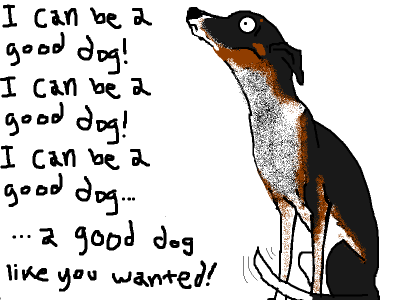
The picture comes from “Hyperbole and a Half,” which I bookmarked half a minute after seeing this.

Wednesday, December 9, 2009

The nose knows


The spousette was out of town this past weekend, and I was feeling at loose ends—OK, lonely—and called sundry chums on Friday in an attempt to set up a dinner party. In the event, only Mary and Eileen had a hole in their schedules, so we were just three on Saturday night, but a jolly trio we were. Napalm the Aged Wonder Dog (seventeen this winter) staggered out to the dining room to check out the guests and then wandered off to spend the rest of the evening in slumber. Ravi the Younger Wonder Dog, perfectly unaware that the day marked exactly one year since he'd landed this gig, posed for a wonderful photograph (above) by Mary Barnsdale, who has an almost preternatural knack for canine photography. I am pleased to post it for the three or four regular readers of this blog.

Sunday, October 4, 2009

In praise of dogs

They ask for so little, really.

Late this morning, as I was attempting to get some things done—well let's be honest, I was thinking about attempting to get things done in those moments I wasn't devoting to reading the political blogs—the dogs were pestering me, which I rather resented. "C'mon!" they were saying (I here essay a rather simple and un-nuanced translation from dogspeak to idiomatic English) "C'mon! It's a beautiful autumn day!" (It was: warm in the sunlight, crisp in the shade. Gorgeous. The Bay Area typically partakes of the Goldilocks' Porridge of North American weather on any given day of the year about three hundred samples out of 365.) "Let's go, let's get out, let's do something!"

I reluctantly put aside my preparations to "get some things done" and drove to the nearby "Linda Dog Park" in Piedmont, a nearby enclave of privilege and distinct municipality surrounded by some of the better districts of Oakland (who are nevertheless forbidden the privileges of Piedmont's separate school district, a policy, living as I do across the street from an Oakland middle school, I cannot bring myself to deplore). There the three of us—elderly Napalm, going on seventeen, and two year-old Ravi—passed the early afternoon from noon to 2:30 as an assortment of dogs and people transited the park. Napalm doesn't ask much of these excursions anymore: a rich assortment of olfactory signals along the main trail provided ample information for his leisured evaluation. Two year-old Ravi had over the course of our hundred and fifty minutes half a dozen playmates, including a couple who helped drain his batteries in games of chase/flee/posture all around the park.

We left shortly before noon and returned here, sundry additional errands run, by 3:30. Napalm sleeps, but at his age that's what he generally does of a given hour. Ravi, who was earlier bouncing off the walls, also slumbers, his batteries discharged for the nonce, in the safety of his "crate." Left to my own devices I would likely not have ventured outdoors for this splendid autumn day. I'm glad that the dogs drew me out. The "things to be done" can be done another time.