Showing posts with label Tech. Show all posts

Sunday, April 17, 2022

Life Turing infowartime


A recent piece in The New York Times—the kind of long-form journalism that, notwithstanding The Paper of Record’s many black sins in its political reporting, keeps me behind the paywall month after month—discusses the extraordinary advances that have been made in artificial intelligence over the past decade and change, with particular emphasis on the ability of cutting-edge “deep learning” software—“Generative Pre-Trained Transformer 3,” hereafter GPT-3—to parse language and to compose it. This is not Siri, or Alexa, or any of the consumer-level “assistants” with which we’re familiar, impressive as these may have seemed seven or eight years ago. Indeed, GPT-3 is not consumer-level at all, and its creators, an outfit calling itself OpenAI, are keeping the thing on a tight leash, because it is a vastly powerful tool the existence of which invites all sorts of possibilities for abuse. “The very premise that we are now having a serious debate over the best way to instill moral and civic values in our software,” the reporter concludes, “should make it clear that we have crossed an important threshold.”

Read the piece if you are able—the NYT would like you to pay for the privilege, and you ought to, but for anyone who for moral, political or financial reasons can’t see your way to purchasing it, there are ways to tunnel beneath the paywall (cough, “private” or “incognito” browsing), and the article really is worth your fifteen or twenty minutes’ attention, if not your coin.

“Artificial intelligence” has long been, rather like commercial nuclear fusion, just around a corner never cleared (“nuclear fusion is thirty years away—and always will be”). Indeed, in the 1950s there was much talk about “electronic brains,” referring to room-sized machines that deployed considerably less computational horsepower than the average cellular phone brings to bear without breaking a sweat. Nevertheless, bold predictions were being made, perhaps not entirely without dreams of sweet DARPA research grants dancing in certain academic heads, of “thinking machines” in immediate prospect. Well, you know, the Industrial Revolution had to start somewhere.

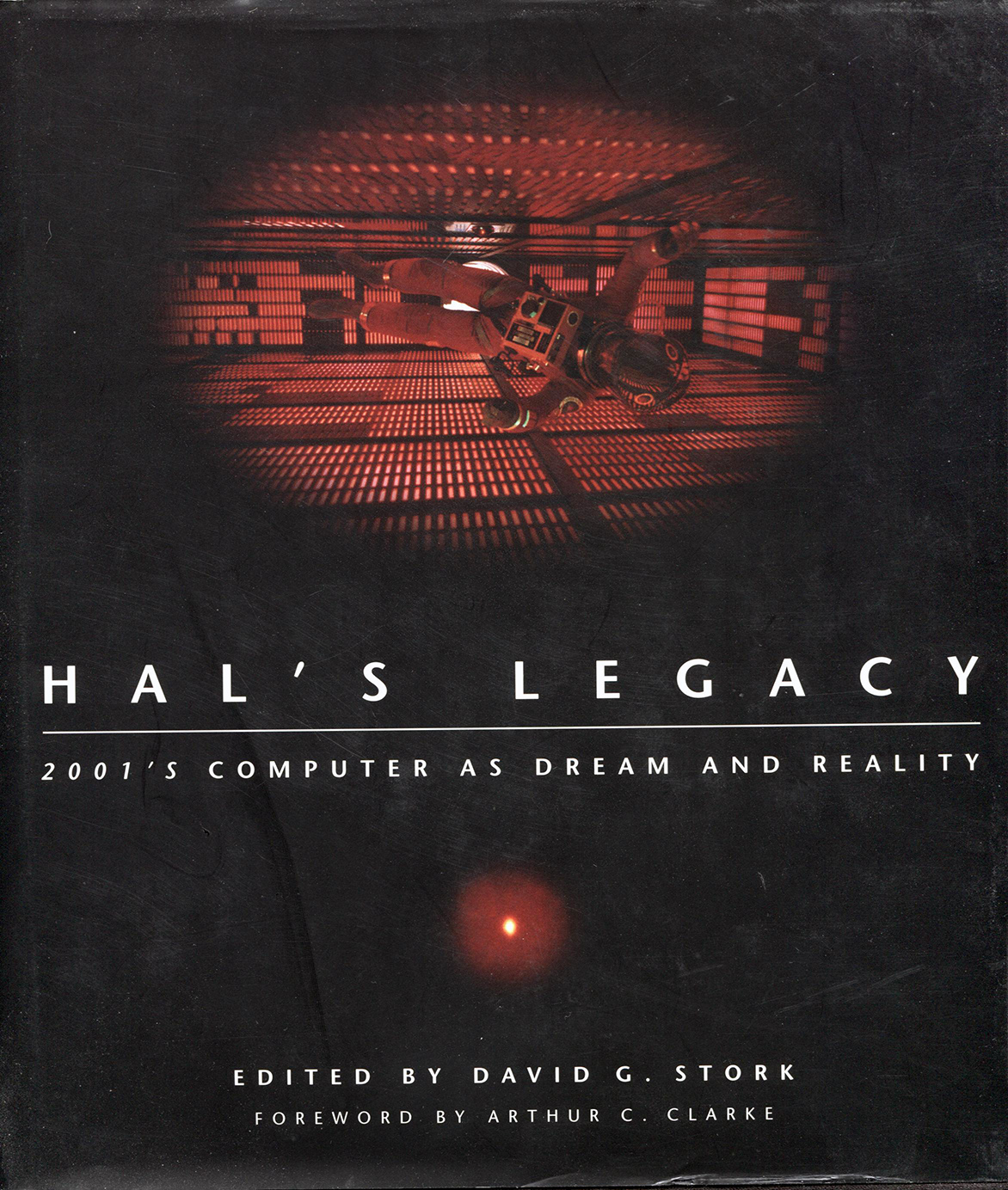
Having read “A.I. Is Mastering Language. Should We Trust What It Says?” I was moved to retrieve (and blow off its integument of dust) from the bookshelf in the hall a 1997 anthology, HAL’s Legacy, a collection of a dozen-and-a-half essays about artificial intelligence, about the vision of this presented in 2001 (a film I regard as a cultural artifact as profoundly expressing the mythos of its era as Genesis and The Iliad did for theirs) and how it inspired a generation, by now two or more, to pursue the grail of software sentience.

Are they there yet? I don’t think so. But they’re a damned sight closer than anyone could have concluded, based on these 1997 descriptions of the state of the art, that we might be by now. Put another way, progress in the field over the past quarter-century considerably exceeds advances made in military aviation between the Sopwith Camel and the B2 bomber. Seriously.

For far too many years the “Turing Test” was one of the measures of machine sentience. Another was chess, but when Kasparov fell to “Deep Blue,” that metric was tossed. As software continues to mimic and meet the Turing standard, the goalposts continue to be repositioned, and with GPT-3’s latest feats, I imagine that they’re way out at the end of the parking lot, if not into the next county altogether.

GPT-3 is not “self-aware.” For one thing, I’m reasonably sure that there’s not a “self” there. Except…except…how sure are we that there’s really a self here in our spongy grey matter? Sure, we feel that, but unless you’re going to go all “soul” on me, I hope that you will agree that human consciousness arises from a kind of “emergent behavior” on the part of a collective of preconscious subroutines, themselves based on dense electrochemical interchanges among our tightly-packed neurons. Machines will likely never replicate the essence of these processes, but I’m less confident that they can’t arrive at something resembling the product.

It is striking how conservative most of the contributors to HAL’s Legacy were. AI, at that point, was still thirty years away, at least, even to the most optimistic among them (possibly excepting Doug Lenat, whose “Cyc” project, perhaps misconceived, and certainly unrealistic given the input resources of the nineties, looks as though it may have anticipated the kind of deep learning that was eventually realizable between the vast volumes of digital intake now at hand and the wherewithal of the processing power that may presently be brought to bear to digest this).

I have said this before, and often, but I believe that, unless industrial civilization collapses—a prospect by no means uncertain—machine sentience will arrive among us. It will probably not be recognized until afterward, and with each evidence of its presence the standard of proof, those goalposts, will be picked up and transported across the state line if necessary. And, you know, the machines may talk to us, absolutely passing the Turing test, and we will still wonder “is there anyone home?” But at that point, it may be that posing the same question to ourselves will be appropriate.

Tuesday, November 17, 2020

First flight, and afterward


Over forty years have elapsed since I first saw a personal computer in operation, in a private residence in Marin County, a tony California precinct. It was an Apple II (or “Apple ][,” according to a curious typographical convention of the day, which I will not bother repeating), owned by a friend’s father, a fiftyish chemical engineer, and it was running, on a green phosphor monitor, and loaded from a cassette drive, a program called “Flight Simulator,” the distant but direct ancestor of the product marketed by Microsoft unto the present day.

A little background: in the initial years of my romantic history I was successively involved with three women who subsequently made their livings in the computer field—even before the (Mis)Information Age had wrapped its tendrils anything like so thoroughly around and through the populace and the polity today—and a fourth who, early in 1974, endeavored in vain to interest me in the computer terminals available for undergraduate use at various points on the UC Santa Cruz campus. “Faugh!” quoth I. “I am a humanities major. What have I to do with these machines?”

A fair amount, it was to turn out, but that proved true one way or another of many of us of a Certain Age.

Anyway, a few years later my then-spouse began to agitate for the acquisition of one of these gadgets, and because what we’d seen was a Cupertino product, we went shopping for an “Apple II+,” the current model as of October 1982, and landed at an outfit—was it in Berkeley or San Francisco?—called, I think, “Quest Computers,” at which a slick salesman (for some reason I still remember his name: Phil Sotter) unloaded on us a computer with 48K—that’s kilobytes—of RAM, a green phosphor monitor, a “floppy” drive and a dot-matrix printer. Woo! I think that the tariff, which we financed by means of a particularly avaricious consumer lender, was initially around $3500, which was probably close to half my net annual salary in those days.

As initially configured, the thing could only display upper-case characters, although it could output lower-case to the printer. Fortunately…er, not quite…fortunately the machine accommodated plug-in cards, and we acquired, for a couple of hundred dollars, an “eighty-column” card that permitted the monitor to display both cases. Did I mention that the software could also do italic and boldface provided the appropriate <tags>were entered</tags> in the word processing environment? But also, the eighty-column jobbie was a little slow: it could not keep up with my keyboard input, and then, as now, I am a fucking two-fingered typist.

Within half a year of taking delivery, although I purchased and played “Flight Simulator” (on a 5.25” floppy—how cool is that?) I could scarcely look at the goddamn machine without hating it, and myself for my folly in consenting to indenture myself to its purchase. The spouse, however, used it to “typeset” several pages worth of content in one issue of Tim Yohannan’s “Maximumrocknroll” magazine—this one. I met Tim Y, dead these many years now, once or twice during that period: he struck me as an exceptionally charmless character.

In late summer 1984 my wife again suggested a computer purchase, this time of an Apple Macintosh, which had first reached the consumer market earlier that year, and which had already struck me as the homeliest piece of consumer electronics I’d ever set eyes on. “Absolutely not,” I growled. “I will never consent to having another product from that loathsome company in my home again.” Perhaps I should mention here that for the nine years we cohabited following our move to Oakland in 1977, I was for various reasons the principal breadwinner as she worked lower-paying, temporary, part-time, voluntary or not-at-all gigs, and that I regarded my views on big-ticket expenditures as accordingly carrying a correspondingly greater weight.

Cannily, she said nothing to this. A couple of weeks later, working late—she was then employed at a software firm on Shattuck Avenue in Berkeley—she called to ask if I could fetch her from the workplace. When I arrived, she apologized, told me that the staff meeting was running overtime, led me to an otherwise empty room with an original Macintosh, the 128K model, booted up and running, I think, MacPaint.

I’d never seen anything like this. When she returned after three-quarters of an hour, I sighed: “Where do I sign?”

Two years later, she’d moved out, and on, to gigs in the IT/tech writing field that paid far more than she—or I—had ever made when we had common premises. But a year after that I began to make my living on the Mac (a story for another time, perhaps), and did so until my retirement in 2017, so yay. I probably could have brought home the same or greater income from the same employer during those latter three decades, but I would not have enjoyed myself as much, and would likely never have attained anything like the sundry technical and artistic proficiencies I can claim today. Thanks you, K. No, really.

I owe this also, I suppose, in minor part to that horrible Apple II+ back in the day. I salute the machine, halfheartedly, in whatever metal-retrieval landfill might have claimed it, you otherwise unmourned old thing.

Monday, September 15, 2014

Further to Tech

After considerable pressure from friends, family, employer, I have at last embraced the Dark Side, and in consequence the number of people in North America who do not own mobile phones has fallen from 250 to 249. I presently look at the device with a certain sour suspicion, but I imagine that a few months from now the Kool-Aid blood levels will have risen to life-threatening numbers. I still don't feel good about this.

The graphic has been lifted, with unauthorized gratitude, from vfxjake.com.

Remembering 2001


No, not that one. The one from 1968.

In the book HAL's Legacy, contributor Donald Norman points out a number of particulars in which the filmmakers were mistaken as to the direction that computer interfaces were to take. What's sad, though, is that, HAL conspicuously excepted (and we now have automated subroutines that can mimic very sophisticated elements of human cognition without, as yet, a trace of actual self-awareness*), a rationally-ordered global civilization could have accomplished much of the spread into space envisaged by 2001: the orbiting wheel, the moon bases, even a manned mission to the outer planets would all have been plausibly within the reach of a planetary society less determined to squander its treasure and energies on plunder and war. Kubrick's vision is a reproach to our failure, and also a transcendent cultural artifact of the last century, fit to stand comparison with Genesis or the Iliad as expressions in mythic terms of their respective civilizations.

*This will, I predict, come about in my lifetime, should I have the misfortune to reach my father’s present age (he’s closing on 93 in another fortnight; I’m 62), and when software sentience is at last detected I suspect it will be some years after the fact.