Showing posts with label kultur. Show all posts

Saturday, July 16, 2022

A surfeit of Murdoch


At the end of 1986, with my domestic arrangements having fallen to flinders, a friend whom circumstances had granted a ringside seat to the debacle pressed upon me her copy of A Severed Head. “Read it,” she urged, “and understand.” Well, truth to tell, the novel hadn’t much to say about the particulars of my situation, but there was an eerie resonance with the tangled skein of personal histories, relationships, delusions and estrangements characterizing that bleak period. Looking back I suppose that, not unlike Murdoch’s fifth novel, the situation was not without its comedic elements (which I think my friend must have detected), but few of its principals were in a position at the time to appreciate these. Still, A Severed Head impressed me sufficiently that, Berkeley in those days still being my cultural center of gravity, I betook myself over the next few months to the used bookstores on Telegraph Avenue to score five or six copies of the author’s other works—which I then left untouched for a third of a century until I was unaccountably moved late this past spring to take up Under the Net, her first novel. For most of the preceding year or so I had been reading mainly histories and biographies (including The Education of Henry Adams in a handsome edition received as a birthday gift forty-nine years ago, to which I found myself at last receptive after reaching its author’s approximate age at the time of its composition), and only began to edge back into fiction recently.

Under the Net (1954) was entertaining, picaresque and ultimately, I thought, pointless, although the inclusion of a movie mogul distantly based on Wittgenstein was an amusing touch, and had this been my sole exposure to the writer’s œuvre I doubt whether I should have been moved to pursue it further, but on the strength of what I recalled of A Severed Head, I prepared to submit my decision to a tiebreaker, and somewhat arbitrarily selected from the backlist on hand her nineteenth novel, The Sea, The Sea (1978), which scored its author the coveted Booker Prize.

Its opening chapters were…exasperating. I recognized that Charles Arrowby, the narrator, was intended to be off-putting, but half an hour in I felt far from certain that I could bear, at that point, another 450 pages (in my Penguin paperback edition) of his company. Screwing my patience to the sticking place, however, I plugged on, my interest gradually engaging, as Arrowby related the tale, discreditable to rational reader, of re-encountering after half a century his first love—in memory a sylph, a soulmate, his very anima; in 1978 a drab, faded housewife unaccountably unwilling to leave her husband to take up again with the boyfriend of her teens, whose importunities to this end become increasingly unhinged. My exasperation never abated, but my interest was engaged.
From here I was moved to take in The Sandcastle (1957), in which a forty-ish schoolmaster becomes infatuated with a young painter who returns his affection, the romance being thwarted by the educator’s dithering and the intelligent machinations of the wronged wife. Next up was the very interesting The Bell (1958), in a 1966 American paperback edition that hilariously misrepresented the tale as a bodice-ripper, and then a reprise of A Severed Head, which did not disappoint upon a second reading.

Thence: The Italian Girl (1964). A misfire. Murdoch published twenty-six novels in four decades, and even her most sympathetic critics do not assert that all of these were of first quality. This one I will not soon revisit. The Red and the Black (1965) was Murdoch’s only “historical” novel, set in Dublin on the eve of the 1916 Easter Rising, and to my mind engaging and quite readable, with the “obsessive lover” note, so prominent in most of the novels I’ve read thus far, not absent, but nothing like as front-and-center as seen elsewhere to date.

A Fairly Honourable Defeat (1970) included a figure recurring frequently if not invariably in Murdoch’s novels: charismatic, enigmatic, demonic, occasionally destructive, as here, in which a visiting academic attempts unsuccessfully to engineer for his own amusement the estrangement of a homosexual couple (a relationship sympathetically, even compassionately portrayed by the author), an undertaking which, as an unintended consequence, results in the destruction of another character, an armchair philosopher, this collateral damage occasioning not a moment’s remorse on the part of the culprit.

I might mention that I took in most of these novels while laid low with The Thing That’s Going Around, which entered the household shortly after mid-June, probably with SWMBO after she attended an outdoor concert a few days earlier. We were flattened sequentially; she first and than, a few days later, your proprietor: it is difficult to maintain social distancing in 1700 square feet. But thank Log for the vaccines and boosters! I was still bedridden by the time I took in The Black Prince (1973), and maybe it was covid and maybe I’d lost patience with Murdoch’s obsessed narrators chasing after young girls or their phantoms, but the exasperation I felt in the opening passages of The Sea, The Sea had returned by the time I closed this one.

Murdoch’s books are not page-turners—sometimes, indeed, they’re a chore to get through—and her prose style, while unobjectionable, is generally unmemorable. In fairness, though, every now and again the lady lights it up and demonstrates what she’s capable of, and on these occasions she boosts her gifts to very high altitudes indeed. It is her intelligence, though, that kept me going through nine novels (and likely through more presently, although for some reason I am willing to acquire only “used” editions, and have scoured and plundered most of the vendors in reach), and her ability to finish strong.

Having completed The Black Prince I craved something at once comparable in points of style and respectability, and also more readily readable and less likely to provoke impatience. A few days later some household circumstances arose that thrust considerations of literary entertainment offstage for the moment. Since then I have found myself drawn in my idle moments (few of those as present conditions permit) to distractions, and to this end the “Aubrey-Maturin” cycle of novels by Patrick O’Brian have answered very well. These are page-turners indeed, not the least exasperating, and as prose impeccable: indeed, Iris Murdoch was among the series’ early champions. So there’s that.

Above: That’s the legendary “Marber grid,” which dominated Penguin cover designs for years.

Friday, April 15, 2022

Scaling the mountain anew


I grew up reading, as they say, “voraciously,” but my diet consisted largely of trash. OK, science fiction, which was as a rule trashy in those days, and very little else. Looking back, I think the first “serious” novel I ever read outside of school assignments was All the King’s Men, which I took in when I was around fifteen or sixteen. Before I was out of high school I went on a Joseph Conrad tear and, at the instigation of my future ex-wife, began reading Hermann Hesse, few of whose books really stood up to subsequent visits. Another high school friend, learning of this, sniffed “Well, the German novelist you should be reading is Thomas Mann.” I later learned that she personally, with adolescent audacity, had not actually read any Mann, but she was the child of a family far better-read than my own, and had picked up the name and reputation by, so to speak, osmosis (a couple of years later I was talking up Mann to my friend’s mother who, amused, asked me if I’d read Proust. This was, I think, the first time that name had been spoken in my presence. “Whost?” I asked, weakly).

Still, I took my friend’s recommendation seriously and, beginning with The Magic Mountain, commenced early in 1971 to chew through the author’s entire œuvre over the course of the next eighteen months. I have come back to Der Zauberberg at approximately seven-year intervals since that time, and earlier this month completed my ninth go-around, just four years since my last.

I can’t really pin down what it is that delights me so about this book, what has kept me coming back to it since the first time I read it at eighteen. Many readers have been bored: one, in an online discussion thread I look in on, recently called it a “snoozefest.” Not for me. The novel has been a different experience each time I have taken it up. This time out was the third or fourth go-around I’ve taken with translator John E. Woods as my cicerone. My first several sessions were with the 1927 H.T. Lowe-Porter translation, to which I had become so accustomed that the first time I looked over the Woods version I was put off: I missed some of Lowe-Porter’s stately cadences. There came a point, though, early in the century, at which, having taken up her rendition anew, I found it somehow heavy sledding. At this point I purchased the Woods translation and have never looked back.

It has been said of Lowe-Porter that she contrived the unlikely feat of translating Thomas Mann into German. He was always puzzled that his English-language audiences saw him as “ponderous,” because his German readership regarded him as a deft prose stylist. He was content, however, to retain Lowe-Porter as his authorized translator, and kept cashing the checks from Alfred Knopf.

Anyway, I have loved the book anew. The set pieces are glorious, of course, but even the passages that have put some readers off—the debates between Settembrini and Naphta, for example—are so much catnip to me. I took it in at about seventy-five pages to a hundred each day, and enjoyed every session. Oddly, I don’t think I have ever persuaded my high school friend to read it, but I remain grateful to her for putting the novel in my way.

Thursday, February 25, 2021

Annals of pop culture


As we close out the first year since this household, at least, became aware that something was rotten in the state of epidemiology, it seems fitting to look back on a couple of the less exalted cultural artifacts we’ve sampled (revisited, actually) during this extended period of house arrest. I mean, it can’t be all Antonioni all the time, can it? Under consideration today are two genre products, The Game (not to be confused with the considerably cleverer David Fincher film from twenty-five years ago) and Silverado, a sort of generic western.

I had supposed the Cold War thriller as a dramatic form to be extinct, like masques or passion plays, or at the very least moribund. After all, even John le Carré, generally considered the greatest master of the genre, felt obliged to move on to depictions of contemporary mischief during the latter years of his long career, although he returned to the classic milieu one last time in portions of his penultimate novel.

But after all, if Regency romances continue to be written and sold, and if an Edwardian costume soaper like Downton Abbey garners rapt audiences on either side of the pond, why should we not find creative spirits drawn to those fraught decades when the Soviet Union and “the West” were ideologically at daggers drawn, each side desiring the extirpation of the rival ethos; each in dread of the other’s intentions and of its ordnance? Now there was an existential threat worthy of some serious knicker-twisting! There’s still drama to be mined

The fact that we know how the story turned out—no one pushed the button; no one perished defending the Fulda Gap; the Red Russians renounced their wicked ways, or at least exchanged many of them for our wicked ways—does pose some issues for the storyteller, which brings us to the entry under consideration here, the 2014 six-part BBC series The Game. There will be minor spoilers in my discussion.

I have alluded to John la Carré, who pretty much holds the patent on Cold War spy fiction, and whose œuvre is the yardstick against which all contenders and pretenders are perforce to be measured. By its major plot elements the series does not merely invite but positively compels comparison with the 1979 BBC dramatization of Tinker, Tailor, Soldier, Spy, and this juxtaposition does not flatter the newer production.

We are once again made privy to discussions in the upper echelons of “British Intelligence” (“The Circus” in le Carré’s world; here doing business as MI5—one of the series’ few unimpeachable touches of verisimilitude) as its senior officers ponder the measures that must be taken to thwart the latest covert assaults by international communism upon the British Way of Life as it is lived in 1972. There are the obligatory touches of moral ambiguity (“alas, we are obliged from time to time to undertake questionable measures in defense of our ancient liberties and our values, and it’s a jolly good thing that the latter are incontestably preferable to those of the foe, else our slumbers would be troubled by the prickings of such vestiges of conscience as we have retained”) that have been expected of British spy fiction since The Spy Who Came in from the Cold. There’s the long-time chief of the operation, like Tinker, Tailor’s “Control” an embattled, lonely figure who has to contend with swinish, obdurate politicals above and scheming, ambitious subordinates beneath. In fact, let’s meet our principals, shall we?

  • There’s the aforementioned chief, a shrewd, corpulent, raddled character known to his team only as “Daddy.”
  • Bobby Waterhouse, Daddy’s deputy: an aging, expensively-tailored (well, by the standards of 1972, I suppose. In one scene the points of his shirt collar terminate somewhere in the neighborhood of his armpits. I am obliged to recuse myself from any critical discussion of the fashion and grooming choices made during this period) nancy-boy who is itching to put the bureaucratic shiv in pater’s back. Bobby’s actual pater is not in the picture, but his formidable mother has a few scenes, and frankly, I’d rely on her to hold the Fulda Gap in a pinch.
  • Wendy Straw, Daddy’s pert secretary (the actress puts me in mind of the young Rita Tushingham), whom MI5 appears to be grooming for field work, being as how the outfit appears to be chronically understaffed (see below).
  • Alan Montag, the bearded Aspergerish tech boffin who can with equal facility paper a room with concealed microphones or wire an intelligence source with a transmitter so small you could fit it into a golf bag. This is 1972, remember.
  • Sarah Montag, Alan’s wife and one of the agency’s top analysts—she’s one of the first to raise aloud the possibility that someone on Daddy’s inner team might be playing for the other side—and a crackerjack field agent. A candy mint and a breath mint!
  • and finally, looking as though he has just arrived on the set from a GQ photo shoot, our protagonist, tousle-haired young Joe Lambe, an even better field agent than Sarah. In fact, he’s the star of MI5, Daddy’s golden boy, and I’m here to tell you that on the evidence of this series, if Joe was the best they had, the UK would have been a Soviet Socialist Republic by 1973.

These are The Spies Who Don’t Know Any Better Than To Come in from the Cold. The story relies repeatedly and unduly on the convenient “idiot plot”: “Yes, mate, we want you to meet a deadly Soviet assassin in this basement room and worm important information from him. And don’t worry. Me and Alan will be monitoring you from our listening post on the tenth floor, and if something looks to go wrong we’ll be down here in, like three minutes.” Or “So you’ve got vital information on a mole within MI5, have you? Well, you’ll be absolutely secure in this safe house—of course it is. Where do you think the expression ‘safe as houses’ comes from? How certain are we? Well if we weren’t certain, we’d have sent someone on ahead to make certain there wasn’t an armed Red concealed in the laundry room, wouldn’t we?” Intelligence assets perish, bad guys routinely elude surveillance (not surprising, since MI5 apparently has only Bobby, Wendy, the Montags and Joe, plus a policeman seconded to the operation, as field operatives to keep tabs on the Bolshies), and the Russians are constantly getting the drop on our heroes. Perhaps more ludicrously, the entire tale requires us to believe that forty some-odd years ago the senior echelons of the British intelligence community were worried sick about the possibility of an imminent Soviet military invasion of the kingdom.

The series has a few worthwhile set pieces, and the latter episodes proceed a little more briskly. Notwithstanding a few red herrings strewn about, I correctly guessed the infiltrator about halfway through. If you fancy a Cold War thriller (or plodder), and are prepared to withhold comparisons with more distinguished examples of the genre, you might be entertained.

*

Like many another child of my generation, I was raised on westerns, and I remain at least mildly partial to the genre, which I suppose is why I put up with Silverado, an unduly formulaic example of the form. This is something of a “paint by numbers” western: one senses the writer/director dutifully ticking off the conventions of the genre one by one. Barroom brawl, check. Free-range ranchers vs. farmers, check. Outlaw hideout in canyon, check. Wise and worldly female saloonkeeper, check. Oily gambler, goodhearted prostitute, check. Taciturn hero, check. Gunfights, check, check, check, check, check. Injuns, inexplicably MIA.

It’s not a bad approach to making a cowboy movie. Contrived, to be sure, and more than a little self-conscious, but those of us who esteem the western expect certain elements, and if your favorite trope has not put in an appearance at any point in the flick, another quarter hour will likely summon it forth. Add to this some decent set design and cinematography, a handsome cast that appears to be enjoying itself and a workmanlike if not altogether memorable screenplay, and it’s two hours well spent, although likely not among the first- or even second-tier of westerns I’ll screen again. Among the cast members, craggy Scott Glenn acquits himself well as the aforementioned taciturn hero, as does Kevin Kline as the hero’s diffident sidekick. Kevin Costner chews the scenery halfway across New Mexico to the Colorado state line, but he’s having so much fun that his otherwise annoying performance compels our indulgence. Danny Glover hits all his marks as the Magical Negro; Roseanna Arquette is briefly on camera as the Love Interest in a role so severely truncated that it probably ought to have been omitted altogether; John Cleese(!) shines in a small part as an honest, by-the-books sheriff who nevertheless maintains a realistic vision of his professional responsibilities, particularly where these involve his personal safety.

The soundtrack by Bruce Broughton is unobjectionable as music, but is deployed in an almost intolerably heavy-handed fashion, and served throughout as an auditory irritant. I appreciate directors (John Sayles in Lone Star comes to mind) who do not feel the need to punch up the orchestra to convey drama, excitement, romance that ought properly be carried by the actors and the camera. Lawrence Kasdan has not learned this lesson.

Summary: a pleasant western pastiche, ably performed and photographed. Not otherwise particularly memorable, and rather less than the sum of its tropes, but nevertheless a diverting evening’s entertainment for fans of the form.

Friday, December 25, 2020

Streaming of a White Christmas


Lina has had us watching a streaming series about Pablo Escobar, but agreed with me that it mightn’t really do for viewing on December 24. I know that the traditional American movies for this occasion are either It’s a Wonderful Life or Die Hard, but we felt that neither of these would be endurable. She vetoed the Alistair Sims  Christmas Carol. All of the Xmas-themed selections on our two services looked intolerably treacly. Ultimately we settled on the 1954 production (Bing Crosby/Danny Kaye/Irving Berlin/Michael Curtiz) White Christmas, which we’d gone all these decades without catching hitherto.

It was curious for us to reflect that this was “popular culture” when she and I were toddlers. The society it depicts is figuratively fat, happy, prosperous, complacent, genially and unselfconsciously sexist, sentimentally militarist (“Gee, I Wish I Was Back in the Army”—easy for you to say, Irving), and, with the exception of a barman in the club car scene, the film features a cast as white as the snow that eventually does fall [spoiler alert] on Christmas in Vermont. I observe none of this by way of sneering—for some, perhaps many of our own cultural assumptions, however self-evident they may appear to us and however comfortably we hold them, must inevitably strike posterity as outlandish or worse—but merely by way of emphasizing how strange it is to contemplate having existed in that milieu, even if its salient characteristics lay at the time entirely outside my own purview.

It was curious as well to consider, not for the first time, that it has been less than a century since, with the introduction of “talkies,” human beings have been routinely granted an experience dreamt of by our forebears for millennia: the phenomenon of seeing the departed dead and of hearing them speak. Talk about ghosts of Christmas past! Crosby, Kaye, Rosemary Clooney, Dean Jagger and all the other speaking parts with just one exception are at present doing business on the other side of the sod, but there they all were, summoned forth from the æther to sing and dance and camp it up for the patronizing delectation of a couple of jaded old coastal urbanites on Christmas Eve. Funny ol’ world.

Saturday, November 28, 2020

Jubilation River

I’ve long been fascinated by the way cultures and societies depict themselves in film (among other media, to be sure). Earlier in the year I watched a couple of Eclipse titles from Japan, Jubilation Street and Black River. The first of these was produced during the Pacific War; the second thirteen years later, with the formal US occupation of Japan ended, but its military presence still very heavily in evidence.

Jubilation Street concerns the dwellers of a Tokyo residential district who are shortly to be displaced as their neighborhood is appropriated for military purposes. The characters regret this development but do not contest the necessity of their removal for the war effort. And in retrospect, after all, Tokyo was shortly to undergo “urban renewal” via the fleets of B-29s dispatched by Curtis LeMay.

Jubilation Street reminds me of Mrs. Miniver, depicting civilians on the home front bravely enduring the depredations of a relentless foreign enemy. The rah-rah propaganda element is little in evidence—there’s a bit at the end, probably included to soothe the sensibilities of the wartime censors. The film brings home to me (I’m a child of the late Truman administration, so I was brought up saturated in pop culture depictions of Nipponese wartime cruelty and depravity) the sense that as the USA brought the war home to Japan, we were punching way above their weight.

Come to Black River in 1957 and we see a demoralized, corrupt, cynical Japan, its traditional values infected and despoiled by the West. The social solidarity depicted in Jubilation Street is long gone: in the squalid quarter in which Black River is set the gangsters and the prostitutes and the indigent struggle and squabble for scraps among themselves. The two films, taken together, present a remarkable contrast.

Monday, August 31, 2020

How far we have come


There was a time—this period would elude the comprehension of my younger readers, if I had any—when the notion of policemen shooting fleeing suspects in the back was presumed to be a characteristic of totalitarian foreign regimes: the Gestapo, of course, in the service of the Third Reich. The East German border guards popping citizens attempting to flee over the wall. Even the Vichy French constabulary in Casablanca as depicted in this piece of popular entertainment in a scene that domestic theatre audiences presumably did not then applaud.

Today? The guy into whose back a Kenosha cop emptied seven rounds is deplored by about forty percent of the electorate as having had it coming for resisting police commands. We’ve come along way since 1942, have we not?

Wednesday, August 19, 2020

Angry in 1963

Like many of us, I’m spending more time indoors than usual this year, and particularly as the Bay Area endures a prolonged spell of warmer than normal weather coupled with oppressive (by local standards) humidity and, today, smoke-laden skies. Although this sedentary way of life is doing nothing, or at least nothing good, for my boyish figger, I have been catching up on both my reading and on a substantial backlog of unscreened films. This is one, La Rabbia, “The Anger,” a curious artifact from 1963. Originally conceived as a meditation proceeding from the opening question “Why is our life dominated by discontent, by anguish, by the fear of war, by war?”, the film began as a kind of video montage, mainly of newsreels of the postwar world up through the early sixties, with a spoken commentary written by Pier Paolo Pasolini (1922-1975). Seeing Pasolini’s finished product, the producer, apparently afflicted with an early case of bothsiderism, trimmed it drastically and invited conservative writer, editor, cartoonist and gadfly Giovannino Guareschi (1908-1968; today best remembered, if at all, for his “Don Camillo” stories) to direct a companion piece along the same lines.

The resulting cinematic portmanteau pleased neither man, each of whom cordially detested the other. Guareschi, at least, knew what he was getting into; Pasolini was dismayed when he found his work yoked to that of the older man. Not surprisingly, each director approached the “modern” plight with different emphases. Pasolini (Marxist, homosexual), dreads the encroachment of American-style consumerism on the Italian proletariat, and applauds the liberation, then in progress, of the Third World from its colonial masters. Guareschi (Catholic, monarchist) despises American vulgarity, and deplores Europe’s withdrawal from its African possessions. Nor is he keen on Marxists, homosexuals or the uppity locals giving the colonialists such a hard time.

Pasolini’s half seems, particularly by contrast with Guareschi’s bitter and caustic take, optimistic, almost lyrical. I think it was still possible in 1963 to see in Khrushchev’s USSR the possibility of a humane outcome to the communist experiment without doing violence to one’s intellect, and Pasolini certainly appears to celebrate that prospect (for more on this subject run, do not walk, to your bookseller of choice and secure a copy of Francis Spufford’s astonishing Red Plenty), particularly in the lengthy paean to Yuri Gagarin’s epochal flight. Guareschi is having none of that, and his own considerably bleaker segment is interlarded with the most damning footage (Hungary 1956, Berlin 1961) that he can find. But Guareschi—whose Don Camillo tales, set in the Po Valley during the postwar years, and centered around the “frenemy” relations of a parish priest and the communist mayor of his village, I read in my youth, and which still retain their charm—hates lots of other things besides Marxism: he hates American popular culture; hates the sexual licentiousness associated with it; hates, hates, hates fags; hates the Africans who have been driving their colonial masters off the continent (“where whites and coloreds lived together in peace and harmony”).

La Rabbia was released in a few theatres, garnered tepid reviews, sank out of sight. Pasolini attempted, unsuccessfully, to have his name withdrawn from the film. Novelist Alberto Morovia published a scathing review of Guareschi’s portion: “When the boorish editor of an unnamable Milan magazine [Candido, founded by Guareschi in 1945] knocks on your door and asks you for an interview, do you let him into your house? When a producer asks you to make a film with Guareschi, do you agree? Don’t you know that you should not welcome the editors of certain magazines into your home? Don’t you know that you shouldn’t make films in the company of Guareschi?”

La Rabbia, nicely restored and released in an edition by “RaroVideo,” is an interesting cultural artifact, and I mainly enjoyed it. I must warn prospective viewers that near the end of the film there is footage of a Soviet experiment— Guareschi has included this as an example of commie depravity—that is perhaps the most shocking example of cruelty to animals that I have ever seen committed to film. It is preceded by diagrams, and I exhort anyone who sits through La Rabbia to avert his eyes for the next couple of minutes.

Friday, March 13, 2020

“The God Abandons Antony”


When suddenly, at midnight, you hear
an invisible procession going by
with exquisite music, voices,
don’t mourn your luck that’s failing now,
work gone wrong, your plans
all proving deceptive—don’t mourn them uselessly.
As one long prepared, and graced with courage,
say goodbye to her, the Alexandria that is leaving.
Above all, don’t fool yourself, don’t say
it was a dream, your ears deceived you:
don’t degrade yourself with empty hopes like these.
As one long prepared, and graced with courage,
as is right for you who proved worthy of this kind of city,
go firmly to the window
and listen with deep emotion, but not
with the whining, the pleas of a coward;
listen—your final delectation—to the voices,
to the exquisite music of that strange procession,
and say goodbye to her, to the Alexandria you are losing.

—C.P. Cavafy

Thursday, February 20, 2020

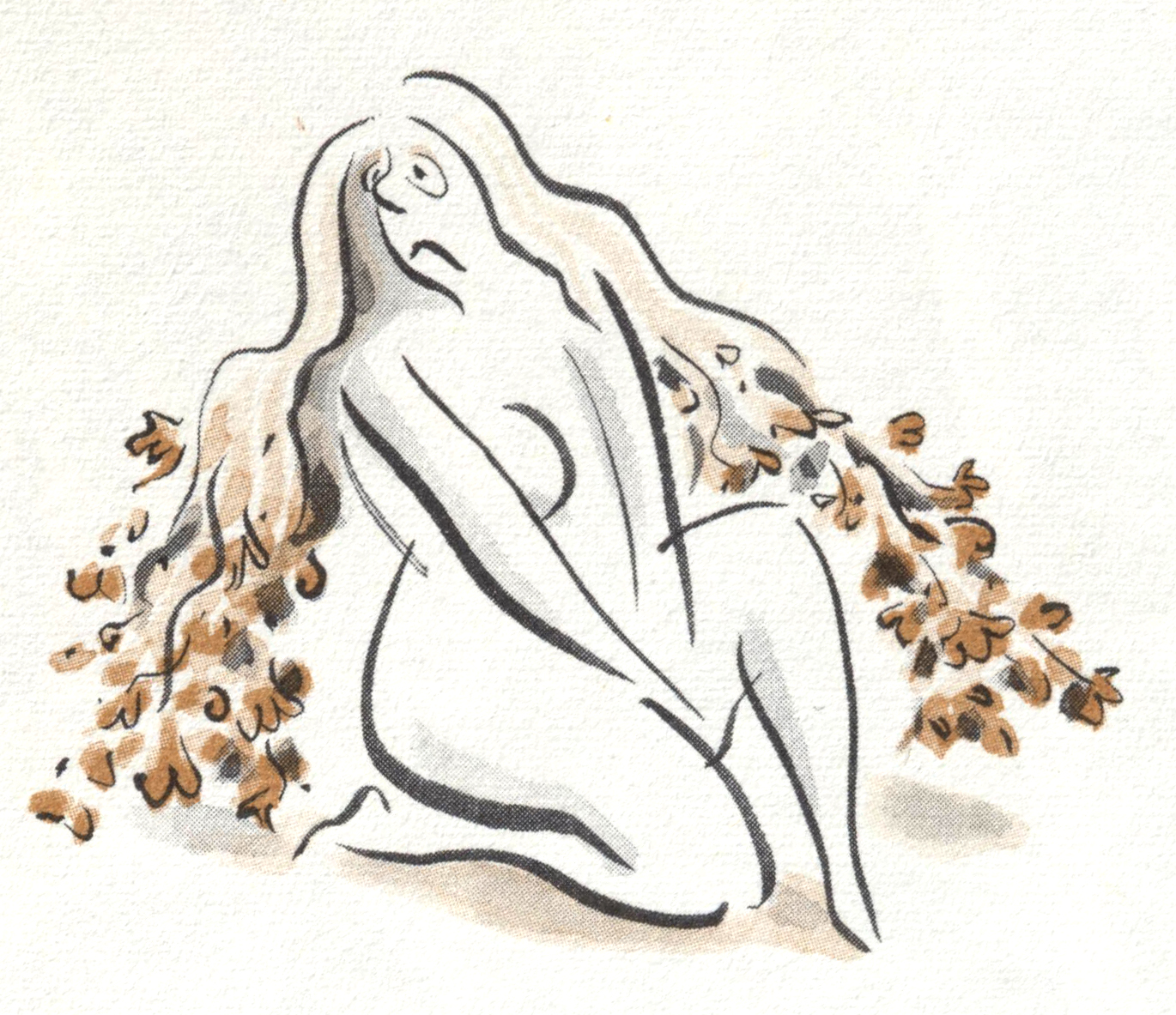
“The Hamadryad of Ragweed”


(The doggerel and the illustration are both by Ed Fisher, and appeared in Horizon Magazine Volume VIII, No. 4, Autumn 1966. I believe today may be the first time these lines have been rendered in machine-readable form.)

In ancient Greece, beside the Wine-
Dark sea, ’twixt earth and ether,
A race of beings, not divine
But not quite human, either,
Inhabited the smiling land
In paralyzing numbers—
In every stream, or every stand
Of oaks, or of cucumbers.

From lowest reed bed by the sea
To loftiest Hymettus
They dwelt in every bush and tree
And every head of lettuce.
No scribe could tally up their ranks,
Nor bold amanuensis
(It would have flooded memory banks
And overwhelmed the census).

Delightful female forms had they
And lovely names like “Aegle”
And “Lotis,” “Lara,” “Dryope,”
And sometimes they were vaguely
Perceived by furtive mortal eye
—A dazzling sight to pitch on
Of perfect bosom, gleaming thigh,
Unhampered by a stitch on.

No wonder, then, the groves of Greece
Were full of would-be voyeurs
And Kings were robbed of mental peace
While Queens consulted lawyers;
The Gods themselves were not averse
To dallying with these Naiads
Though Goddesses would weep and curse
And mutter jeremiads.

Nor were the Nymph and Naiads loath
Nor overly retiring;
Their job of fostering the growth
Of plants was uninspiring;
They found it hard to be demure,
To stick to girlish chatter
Or to delight in what was pure-
Ly vegetable matter.

So, now and then, from every stem,
Or pool, or branch arboreal
A lovely figure would emerge,
Aquiver and corporeal,
A blush or two, a soft “yoo-hoo”
—A male would catch a sight of her;
A “view halloo!” a hot pursue,
And then he’d make a night of her.

The forests rang with constant cry
Of men and Gods and Satyrs;
While from their beds amid the rye,
The tulips and the taters,
The Dryads rose, took shape, displayed
Their succulent totality—
No Self-denying Ordinance stayed
Their consummate carnality.

The Nymphs of Oak and Elm enjoyed
A string of peccadilloes,
The Ferns were constantly employed,
And so were all the Willows;
The Cowslips were a frequent catch
In countless lustful gambols;
Despite a tendency to scratch
So was the Nymph of Brambles.

Alone amidst this lightsome set
One lovely creature languished
With downcast cheek and eyelids wet,
Emitting murmurs anguished;
Untouched, unbroached, for her the joys
Of love remained untasted,
Though oft approached by men and boys
Their efforts were quite wasted.

For from her lips and nostrils proud
And from her hair’s gold glory
There swirled an irritating cloud
Of tiny 𝘮𝘪𝘤𝘳𝘰𝘴𝘱𝘰𝘳𝘢𝘦
That cast the most appalling spell
On all would-be attackers
That made them cough and itch and swell
And sneeze like firecrackers.

Thus wracked, no lover could begin
(Though she submitted docilely);
They’d try, with flaming eye and skin,
“Kerchoo-ing” most colossally,
To make a pass, embrace, or pet,
To rise above distraction
—But neither lass nor lad could get
A moment’s satisfaction.

No hardy hero of the Greeks
(Accomplished womanizers,
To whom a maiden’s kicks and shrieks
Were merely appetizers)
Could face resistance such as 𝘵𝘩𝘪𝘴
So shameful and so baffling,
Could boldly grasp or blithely kiss
While sniffling and snaffling!

And though from far and near they came
Determined on a try at
Her scatheless virtue, none could claim
The Ragweed Hamadryad.
Brave Spartans, hardy men of Thrace,
And wily Trapezuntites
All fled her pollen-flushed embrace
With volleys of “𝘎𝘦𝘴𝘶𝘯𝘥𝘩𝘦𝘪𝘵𝘴!”

Even the thirsting Gods above
Could only heave a sigh at
The unpossessed attractions of
The Ragweed Hamadryad.
Priapus raged and Bacchus wept
And Comus was no calmer;
Despite these fits they primly kept
A healthy distance from her.

At last, one day, great Zeus looked down
And found her figure pleasing;
With knowing smile and tucked-up gown,
His bolt and sceptre seizing.
He stepped to earth; they met, they clasped,
In raptures paroxysmic
They tossed like ocean vessels grasped
By forces cataclysmic.

The heavens blazed as, wildly, crazed,
They spent their passions hoarded
While passing strangers stopped, amazed,
And recklessly applauded;
And when at last she cried “enough”
He rose up, enigmatic,
And promptly vanished in a puff
Of multicolored static.

This Mightiest of Scamps had done
What legions had attempted;
From ragweed pollen he, alone,
Seemed totally exempted.
With greatest ease he’d won the prize
This courier anointed,
Nor cough, nor sneeze, nor red-of-eyes
Had stayed his rounds appointed.

And all the Greeks with paeans praised
His feat apocalyptic
But when the 𝘩𝘰𝘸 of it was raised
Great Zeus’s smile was cryptic;
He kept his questioners at bay
And kept his reputation.
In truth, his only secret lay
In Careful Preparation.

—This Romeo, before the show
And well behind the scenes
Had smeared himself from head to toe
With antihistamines
And thus protected had attained
His triumph transcendental
But to the public he explained:
“All allergies are mental.”

Friday, January 17, 2020

Not that future—the other one

Noted commercial illustrator Syd Mead, the “visual futurist,” pegged out at the end of last year. Most of his work had the vibe of the Sixties dialed up to eleven: sleek, stylish, streamlined, almost antiseptic in its modernity; the twenty-first century as James Bond might have imagined it, partaking much more of The Jetsons than of Blade Runner—although of course Mead had a considerable hand in the design of that dystopia. At least he made it past November 2019.

Monday, January 6, 2020

Living in still another future

Welcome to “The Twenties.” It’s a relief getting back to a decade naming convention that rolls off the tongue, unlike the last two. On the other hand, it appears likely to be a dire one content-wise, and there’s a not-inconsiderable possibility, at my age, that I won’t feature in the opening credits for “The Thirties.”

“Science fiction” has historically tended to be blinkered by the era in which it’s written, so that, for example, descriptions of spacecraft controls used to feature a lot of buttons, switches, and needle gauges. Sociologically, likewise, there wasn’t much thought—making the honorable exceptions stand out that much more vividly—given to, say, how gender roles might evolve. But even a blind squirrel, et cetera, and I’m struck by the prescience of Year of Consent, an otherwise unmemorable mass-market paperback in which the implications of applying modern advertising techniques to politics, pioneered just two years earlier by the Eisenhower campaign (I like Ike, but we’re still living with the consequences of a lot of questionable decisions made in his name, starting with that year’s VP pick and, most recently, with the 1953 interference in Iran) are pondered.

I picked this up for fifteen cents under its original purchase price when a small bookstore went out of business a few years ago (the proprietor was a good guy, but perhaps temperamentally unsuited for retail: when I’d place my pile of purchases on the counter he would spontaneously discount them: “Seven dollars?…I dunno, maybe four?” “No,” I’d explain, “that’s the way it works when you’re buying”). Published in 1954, Year of Consent depicted the dire world of 1990, when the seventy-four United States of America are governed by marketers, psychologists and “social engineers”:
The administration wanted to know as much as possible about what everyone thought and felt. What people ate, where they spent their vacations, what they talked about—all of these things were added up and passed through SOCIAC to produce complete pictures of individuals and groups. Thus, when the administration wanted to make a new move, they knew exactly how to condition the people so that it would be backed. Or they knew exactly what sort of man to put up to win a popular election. This, then, was government by consent.
Remarkably, this apparatus of manufactured consent is coordinated by a massive computer with approximately the horsepower of a first-generation “IBM PC.”:
Even in the elevator I was conscious of the vibrations, like an inaudible hum, of SOCIAC at work. The giant electronic brain filled up the first ten floors of our building. There were additional memory banks in several subcellars and in another nearby building. It was impossible not to be in awe of it [Try me —Ed.] Just as an example, it contained about 500,000 electronic tubes and about 860,000 relays. Not counting the extra memory banks, it had 400 registers totaling 6,400 decimal digits of very rapid memory in electronic tubes and about 6,000 registers totaling 120,000 digits of less rapid memory in relays.
Needless to say, punched cards are involved. Well, even Vannevar Bush’s remarkable “memex,” which was envisaged as having something like the capabilities of a modern personal computer with the Wikipedia homepage open, was conceived, in his 1945 essay “As We May Think,” in terms of microfilm and conventional projection. The hardware of Year of Consent’s dystopia is anaemic, of course, and its political environment monolithic, with a single governing authority wielding these powers of mass manipulation rather than the anarchic struggle for influence that rages around us today—although see modern China for something closer to Crossen’s vision and, perhaps, our future.

Kendell Foster Crossen worked in a number of genres over the course of his career, and also created the “Green Lama,” a Buddhist(!) superhero who was featured in stories, comics and radio programs (“The Green Lama is an alias of Jethro Dumont, a rich resident of New York City, born July 25, 1903, to millionaires John Pierre Dumont and Janet Lansing. He received his A.B. from Harvard University, M.A. from Oxford, and Ph.D. from the Sorbonne; he also attended Drepung College in Tibet. He inherited his father’s fortune, estimated at ten million dollars, when his parents were both killed in an accident while he was still at Harvard; he then spent ten years in Tibet studying to be a lama, acquiring many mystical powers in the process. He returned to America intending to spread the doctrines of Tibetan Buddhism, but realized that he could accomplish more by fighting crime, since Americans were not ready to receive spiritual teachings”). Crossen lived long enough to see the Eisenhower campaign’s crude techniques refined and deployed by Roger Ailes on Nixon’s behalf in 1968, and further extended to elect Ronald Reagan in 1980. One feels that he might not have greeted our “social media” world with unalloyed enthusiasm.

Wednesday, September 25, 2019

When in Rome

(Another in a series of repurposed film reviews from 2016. tl;dr version: On a state visit to Rome a bored and exhausted European princess escapes from her handlers and stumbles into the keeping of an opportunistic American reporter, who sees in her the newspaper story that will make his career, provided he is prepared to be caddish about it. Aw, hell, who are we kidding? It’s Gregory freaking Peck, and you know that he’ll do the right thing in the end because, after all, he falls in love with Audrey Hepburn. So, beginning with this picture, have a couple of generations of moviegoers. Photographed in creamy black & white on location in the Eternal City, Roman Holiday might have been a mere piece of fluff in lesser hands, but a magical confluence of director, screenplay and cast makes it, on the contrary, a piece of fluff for the ages.)

Even the casual fiilmgoer will have noticed from time to time a convention in movie title sequences that goes something like this:

[Really Big-Name Star]
(and sometimes)
[Equally or Almost as Big-Name Star]
in
[Movie Title]
with
[Actor Name]
Actor Name]
[Actor Name]
(and sometimes)
[And Another Big-Name Star]
as
[Character Name]

The Hollywood film industry is one of the more rank-conscious fields of human endeavor, and for many, many decades the placement of an actor’s name before the film title was a signifier of very high status indeed. Gregory Peck was nominated for an Academy Award in his second film, in 1944, and by his nineteenth, Roman Holiday, he was an A-list star routinely granted the coveted top-o’-the-title slot in the credit sequence. Audrey Hepburn, by contrast, was just starting out in 1953—she’d had what amounted to a couple of walk-on parts before she was cast, largely on the strength of her stage performance as the title character in Gigi on Broadway the previous year, as the female lead opposite Peck. Because she was virtually unknown to the moviegoing public, the most she might ordinarily have expected would have been an “and Introducing Audrey Hepburn,” which was the sort of token recognition studios were in the practice of giving first-time actresses whom they hoped might become better-known over time. Peck, however, before the film’s release, went to the studio chiefs and said in effect, “Look, you know and I know that Audrey’s going to bring home the Best Actress Oscar for this, and the rest of us are going to look like complete clowns if her name isn’t above the title.” And so, rare for a fledgling starlet, her name appeared up front. The studio never regretted it.

Some have said that the movie’s Princess Anne was the role that the actress was born to play. What they meant was that Audrey Hepburn was the role Audrey Hepburn was born to play, and she incontestably did so to perfection, although this also limited from early on the range of roles she’d be offered, and perhaps she never did reach her full potential with so many gamine roles stacked up waiting for her to perform them: lazy directors just wanted her to be herself, or at least her image.

This mid-century fairy tale begins, as so many fairy tales will, with a princess: “Princess Anne” is touring the capitals of Europe on behalf of her unnamed country (presumably not the United Kingdom, since London is one of the capitals she is depicted visiting in newsreel footage), and her entourage has tightly scheduled every waking hour for her. She’s getting bored, tired and cranky. Sure, first-world problems and all that, but after all, being a princess in European royalty has been known, even in living memory, to be a bit of a drag, with the princesses in question being treated variously as trade goods and as brood mares in the service of dynastic succession. It’s not all musical numbers and singing animals, let me tell you. Anyway, after she pitches a mild tantrum, Anne’s handlers stuff her full of tranquilizers to calm her down. These appear instead to have the unanticipated effect of parting the princess from a normal person’s fear of falling from a great height, and she nimbly escapes from an upper floor on the embassy grounds and onto the streets of Rome (smuggling herself to freedom disguised as a load of soiled laundry inside a delivery van, if I recall aright) before she passes out. If she tried such a stunt today, of course, Audrey/Anne would likely find herself in a Tunisian brothel when she came to, but this is a fairy tale, remember, so instead she doesn’t completely lose consciousness until she has first run into stand-up guy Joe Bradley (Gregory Peck), a lazy reporter for an American wire service who, initially unaware of Anne’s royal identity, reluctantly takes her to his small apartment, where nothing untoward happens. He draws the line at giving up his narrow bed, and makes the girl sleep on the divan—there are limits to knight-errantry!—but before she revives in the morning he has checked in briefly at work, where he realizes to whom he has extended his hospitality. He rushes back to his flat and moves the sleeping princess onto the bed so that she won’t know that she only rated the divan. A favorite scene, early on: Anne, still a bit groggy from the drug, wakes up in Joe’s apartment, in Joe’s bed and in…”Are these your pyjamas?” “Umm-hmmm.” A look of panic crosses her features, and her hands dart under the covers. Joe, drily: “Lose something?” Anne (with visible relief): “No.” That was pretty racy stuff for 1953.

There follows an enchanted interlude of cross-purposes as Joe, his photographer pal Irving, and the princess tool around Rome, visions of Pulitzer prizes dancing in the men’s heads, with Irving surreptitiously snapping photographs of the royal, who is innocently unaware that her incognito has been compromised, or that she is being squired around the city by a couple of jackals of the press. Meanwhile, of course, everyone’s in a panic back at the embassy, and badass-looking truant officers are flown in from home to track down the country’s delinquent princess. Anne has only a few hours out from under her professional responsibilities (“I’m in public relations,” she tells Joe at one point), but Joe and Irving help her make the most of them and ultimately cannot bring themselves to betray her trust.

Certain films appear to have been made under a supremely favorable alignment of the stars: there’s a reason that Casablanca (the cast and crew of which didn’t realize they were working for the ages) is beloved today. Carol Reed’s The Third Man is, albeit on a higher level of artistry, another one that clicks on all cylinders, and I submit that it’s tough to conceive how Roman Holiday could have been any better than it was. Gregory Peck used to joke that for years it was certain that any role he was considered for had first been offered to Cary Grant. So it was with Roman Holiday, and you know what? It wouldn’t have worked as well. True, Peck had to stretch a bit to portray his character’s raffishness, which Grant could have communicated in his sleep, but by the same token it’s hard to imagine Grant matching Peck’s bedrock solidity and decency: there would inevitably have been a knowing smirk to spoil the illusion. The producers wanted Elizabeth Taylor to play the princess: I do not think that the film would be remembered today had they got their way.

Fortunately, posterity has been delivered a perfect movie, shot on location(!) in Rome(!!), a romantic comedy overlaid with a poignant fable of of duty, escape, responsibility, renunciation and decency, in which a princess sacrifices freedom and perhaps love for the obligations laid upon her, conjoined with vast privilege, by rank and birth, and an ambitious reporter foregoes professional success and a nice bundle of cash as chivalry summons him to the better angels of his nature. And to return for a moment to the subject of movie credits, the screenplay was written by one Dalton Trumbo, a gifted victim of the Hollywood “blacklist” whom no one in 1953 would hire because of his supposed communist affiliations. Upon the original release the script was credited to another writer, a common practice at the time, and won an Oscar for best screenplay, which Trumbo of course could not acknowledge or accept. His name was finally restored to the credits in the 1990s, and the Academy at last gave him that Oscar, a gesture he would doubtless have appreciated had he not been, like, dead for a couple of decades by then.

Friday, September 13, 2019

“Are you looking at me?” – One-Eyed Jacks

I’m going to go out on a limb here and call One-Eyed Jacks incontestably the finest western ever shot in Big Sur. This troubled production, helmed by star Marlon Brando after original director Stanley Kubrick quit or was fired (accounts differ), had gone way over schedule and over budget by the time the would-be auteur grew bored with the project and left it in mid-edit for the studio to assemble (the Paramount executives opting, not surprisingly, for the most conventional of the several endings Brando shot, some under duress).

The final product, though scarcely without flaw, nevertheless remains after half a century a compelling if undisciplined piece of work. Karl Malden (”Dad” Longworth) and Brando (”Kid” Rio) portray bank robbers working the lucrative Mexican market who are parted by mischance and meet up again in California after half a decade, having in the meantime followed dramatically different career paths, with Dad pursuing a career in law enforcement while the Kid busies himself for most of this period crafting artisanal license plates. Their reunion is, to put it mildly, fraught.

Beautifully photographed (the Death Valley and Big Sur sequences particularly), with several memorable set pieces. The marvelous supporting cast includes a lot of John Ford regulars, including Ben Johnson and Slim Pickins, and the love interest is the luminous and tragic Pina Pellicer, whose reputed on-set romance with the charismatic leading man turns out to have been a publicist’s cynical fantasy: Pellicer played on Team Sappho. Long neglected, the film fell into the public domain, and has hitherto been available for home viewing only in atrocious no-name “budget” editions which, as an industry informant told me once, “look like they’ve been mastered by someone’s dog.” It has now been meticulously restored for the 2016 Criterion release. 

Wednesday, May 22, 2019

A tale of two adaptations

In considering Andrew Davies’ brilliant 2005 adaptation of Bleak House, it seemed appropriate to revisit both the earlier 1985 television version with Diana Rigg and Denholm Elliot, and also to reread the novel itself as the baseline from which to take the measure of the two productions.

On the evidence so far, long-form television is the best medium yet devised for translating the novel—or at least any novel of significant depth and complexity—into dramatic form. We may perhaps take the recent tendency in motion pictures to draw upon comic books for their source materials as a tacit acknowledgment of this truth. To bring a perfectly faithful rendering of Charles Dickens’ sprawling novel to the screen would likely require an undertaking approaching the brute duration of The Sopranos or Game of Thrones, and since on both occasions, 1985 and 2005, the BBC elected to tell the story in eight hours, a certain amount of judicious pruning of the author’s mad proliferation of subplots, a culling of the minor characters who scamper through his pages, was perforce required. Both versions preserved and ably presented the meat of the tale, although each naturally differed from the other in points of emphasis and of omission.

It seems to me that any dramatization of Bleak House will absolutely require the four principal parts to be competently written and performed, and this requirement has been met for both. The roles to which I refer are Lady Dedlock, the haughty aristocrat with the tragic past (Diana Rigg, 1985; Gillian Anderson, 2005), John Jarndyce, the nicest man who ever lived (Denholm Elliot/Denis Lawson), Tulkinghorn, the baleful, censorious lawyer who has it in for Lady D (Peter Vaughan/Charles Dance), and Esther Summerson, the waif grown to young womanhood, and the beating heart of the story (Suzanne Burden/Anna Maxwell Martin). The lovers Richard Carstone and Ada Clare, “the wards in Jardyce,” are capably portrayed in each series, but not, I think anything like as essential to dramatic success as the first four named roles.

Among the secondary characters the actors portraying Smallweed, the moneylender, Krook, the gin-soaked hoarder, Snagsby the stationer, Bucket the detective, Guppy the unctuous striver and Skimpole, the odious freeloader, all acquit themselves honorably (well, obviously dishonorably in Skimpole’s case). The “Jellaby” and “Turveydrop” subplots are scanted in the Davies screenplay and omitted altogether in Arthur Hopcroft’s 1985 treatment, to no great detriment of either dramatization. Dickens purists might object to Davies’ creation of a new character, Clamb, out of, as it were, whole cloth, but this minor figure deftly and economically discharges a few narrative functions that might otherwise have required some cumbersome exertions on the part of the screenplay.

I find no fault in the 1985 Bleak House, and yet in almost every particular it seems to me that the 2005 model wins on points. Taking performances to begin with: Diana Rigg inhabits her role with properly aristocratic icy hauteur, and so conveys her character’s air of condescension in some matters and indifference to the rest that it is a little difficult to see in this fortyish jaded patrician the passionate young woman who gave herself half a lifetime before to a dashing young officer. As thespian craft, and in fidelity to Dickens’ conception, without fault, but as Lady Dedlock’s doom inexorably descends upon her, that remoteness infects us with some of her own detachment, and the resonance of her fate is diminished in like degree. Anderson, equally proud, equally languid, equally brittle, permits us glimpses of the buried grief and remorse she carries within her, and the scene in which she opens her heart briefly to her lost daughter is borne upon the viewer with considerably greater emotional force. I might mention that Sir Leicester Dedlock, Baronet, seems a little too decrepit in the newer production as against the older.

As to John Jarndyce, the preternaturally beneficent master of the eponymous Bleak House, there is little to choose between the performances of Denholm Elliot and Denis Lawson, although the character is better developed in the latter production. Either man could have been swapped into the other script, and would have performed with distinction.

The two portrayals of the malefic Tulkinghorn, legal advisor of long standing to the venerable Dedlock clan, present a fascinating contrast: the writing of the parts, drawing as it does upon the authorial dialogue, is not so very different, but the performances could scarcely stand in greater contrast. I think Dickens might have preferred Peter Vaughan’s portrayal: his Tulkinghorn is dried-out, all dust and stale paper, an embalmed, desiccated presence in the story, whose menace is of the creeping, inexorable kind, like a wasting disease. Charles Dance, by contrast, carries himself with a coiled tension, an icy malevolence, a deadly readiness to strike in a moment—he’s Dracula to Vaughan’s Mummy. I assign Vaughan’s turn, with its musty reek of mildew clinging to buried secrets, points for a greater resemblance to and a very effective depiction of the character as originally conceived, but Dance’s interpretation, carrying with it that whiff of cordite suggesting those same secrets’ imminent detonations, makes for better television, I think.

The character of Esther Summerson is, as I have described her above, the heart of the story in the novel as in both television adaptations, and here each of the dramatizations stand head and shoulders above the source material, because as written Dickens’ Esther, IMHO, is a narrative miscalculation. My wife once remarked how seldom it was that male writers seemed to be able to inhabit female characters. She made this observation in the course of being pleasantly surprised to find an exception to this trend in one of Ward Just’s novels. Bleak House would not have surprised her: those portions of the novel (mercifully not all of them) consisting of Esther’s first-person narration are almost howlingly unpersuasive, and her self-portrayal is timid, mousy, irritatingly self-effacing—one wants to drown her in treacle. When we first meet her, Esther is approximately twenty. The two television Esthers, Suzanne Burden and Anna Maxwell Martin, were twenty-seven and twenty-eight respectively when the 1985 and 2005 dramatizations aired. Both women give more spirited performances than one might have expected, rescuing Esther from the almost sanctimonious self-effacement her original author assigned to her. This said, Burden’s performance is studied and workmanlike. She is the more conventionally pretty of the two actresses (on the page, Esther makes much of her supposed plainness), and also looks somewhat older. Martin, at that point in her career, could have been mistaken for a girl ten years younger, and her unconventional features—in interviews she has lamented a lack of prominent cheekbones—persuade the viewer that Esther might imagine without affected self-deprecation that “my face will never be my fortune.” At the same time, it is equally easy to see how her visage might captivate the lovelorn Guppy, whose initially comic wooing of her gradually shades toward outright stalking.

One consequence of Martin’s more girlish countenance (against which the gravitas of her performance is set off to considerable effect) is that when her guardian Jarndyce at length proposes marriage, there is decidedly something of a squick factor that enters into the scene, largely absent in the 1985 version.

The two Guppies make for an interesting study in similarities and contrasts, having to do principally with the physical differences between the performers. Actor Jonathan Moore, in 1985, is one of those men whose features seem too small for his face. He’s soft, doughy, a veal calf taken human form, where Burn Gorman, twenty years later, is more ferret-like in appearance. The two are equally smarmy and oleaginous in their attentions, and their respective Esthers correspondingly appalled at the unwelcome courtships to which they are subjected. The two performances are on a par, but Gorman’s, as written, is the better developed.

As this brief essay is less a review than a comparison, I’ll conclude merely by saying that both productions are worthy and watchable, but if life’s too short for sixteen hours of Bleak House, then choose the 2005 version.

Monday, May 13, 2019

Paradise Glossed

I have lately revisited Paradise Lost, which I last read with reluctant attention and imperfect comprehension as an inmate in a freshman English Lit survey course nearly half a century ago. Although the work remains tough sledding, not the sort of thing you’d want to take in at a bustling airport in the course of a layover, I found myself at this sere point in my life, with considerably more cultural context under my belt (would that cultural context were all I had accumulated there!), better appreciating it. Milton’s gender politics will not strike the modern reader as particularly or even remotely “woke,” but I’m not a big fan of holding authors long dead to modern standards of belief, if only in the vain hope of soliciting like slack from posterity regarding my own shortcomings. He was a puritan and a republican (as this latter term was understood in the mid-seventeenth century England), having little use for the papacy and monarchy, respectively, as is evident in the poem. His descriptions of the starry firmament, reflecting as they do a cosmology then in flux, are fascinating.

I have taken the liberty of condensing and paraphrasing the “Battle in Heaven” sequence from Book VI, recasting it from blank verse to closet drama:

God: I’m calling this meeting to announce that I’m naming my son—you all know God Junior—CEO. He’s going to be in charge of day-to-day operations going forward. I’ll remain as Chairman, but all you seraphim and cherubim will be reporting to him from now on, which is to say unto eternity. And you know, at this time it might be a good idea for the entire Heavenly Host to do some serious genuflecting, and to sing a few hosannas to Junior, if you want to stay on My good side. Not, you understand, that I have an actual side, being omnipresent and all. It’s, you know, a—what do they call it?—a metaphor. Anyway, just, like, do what he says, and everything will be copacetic. Any questions?

Satan: This is bullshit! You’re jumping your kid up to the executive suite over senior management? What the hell for?

God: Speaking of hell…

Satan: Fuck if I’m going to bow and scrape to this squirt! Who’s with me?

(A full third of the shareholders walk out with him.)

Satan: The Old Man’s losing his grip. We need to mount a hostile takeover, and by that I mean hostile.

(Next day: the dissident faction assaults heaven. They’re outnumbered, and, after a certain amount of cut-and-thrust swordplay, soundly beaten. Plenty of ichor is shed on both sides, but these immaterial spirits have impressive powers of regeneration.)

Team God: Hurrah!

(Overnight: Satan devises cannons.)

(Next day: Team Hell’s artillery routs Team God at first, until TG drops a mountain range on TH. Series now 2-1 Team God.)

Team God: Hallelujah!

(Next day: Team Hell rallies.)

Team God: Jesus, you guys! What’s it going to take?

God’s Son: You rang? [to God] Now, Pop? Now?

God: Sure. Sic ’em, Junior.

(God Junior puts paid to Team Hell, and sends the lot into th’ lake o’ fire.)

God: Good work. Remind me to punish humanity once I get around to creating it next week.

God’s Son: Will do, Pop. Listen, about the whole, you know, “redemption” business…?

(fade to black: “To Be Continued”)